

How Successful Has The Clean Air Act Been In Reducing Air Pollution
The Maryland Healthy Air Act
Main_Content
The Maryland Healthy Air Human activity (Annotated Code of Maryland Environment Championship two Ambience Air Quality Command Subtitle x Health Air Deed Sections ii-1001 - 2-1005) was developed with the purpose of bringing Maryland into attainment with the National Ambient Air Quality Standards (NAAQS) for ozone and fine particulate matter by the federal borderline of 2022. The human activity and the subsequent regulations besides requires the reduction of mercury emissions from coal-fired electrical generating units and significantly reduces atmospheric deposition of nitrogen to the Chesapeake Bay and other waters of the Land.
The Healthy Air Act is the toughest power establish emission police force on the east declension. The HAA requires reductions in nitrogen oxide (NOx), sulfur dioxide (SO2), and mercury emissions from big coal burning ability plants. The Healthy Air Human activity also requires that Maryland become involved in the Regional Greenhouse Gas Initiative (RGGI) which is aimed at reducing greenhouse gas emissions.
NOx is the most important pollutant contributing to Maryland's basis-level ozone or "smog" problem and besides contributes significantly to nitrogen pollution in the Chesapeake Bay. SO2 is the most important contributor to Maryland'due south fine particulate air pollution problem and besides has a pregnant office in creating regional haze that degrades visibility.
The Maryland Department of the Environment (MDE) is charged with implementing the HAA through regulations. The HAA regulations constitute the near sweeping air pollution emission reduction measure in Maryland history. The HAA regulations became effective on July 16, 2007.
Overview of Expected Emission Reductions
Over 95 percent of the air pollution emitted from Maryland's power plants comes from the largest and oldest coal called-for plants. The emission reductions from the Healthy Air Act come in 2 phases. The beginning stage requires reductions in the 2009/2010 timeframe and, compared to a 2002 emissions baseline, reduce NOx emissions by almost 70%, SO2 emissions by eighty%, and mercury emissions by 80%.
The 2d stage of emission controls occurs in the 2022/ 2022 timeframe. At total implementation, the HAA will reduce NOx emissions by approximately 75% from 2002 levels, SO2 emissions will be reduced past approximately 85% from 2002 levels, and mercury emissions will be reduced past xc%.
Frequently Asked Questions
- What's the solution to cut air pollution in Maryland?
- Which emission sources are affected by the rule?
- Which pollutants are covered by this dominion and how much pollution will exist reduced?
- How does the Salubrious Air Act compare to the federal Clean Air Rule?
- Does the rule bring Maryland closer to meeting federal air quality standards?
- What is Maryland doing to address pollution in upwind states?
- How does the Salubrious Air Human activity benefit the Chesapeake Bay?
- Why do nosotros demand to reduce NOx and SO2?
- What are the adverse health furnishings of long-term exposure to fine particulates and ozone?
- Where tin I observe more data about air quality in Maryland?
What'south the solution to cut air pollution in Maryland?
The Maryland Healthy Air Human action is the most sweeping air quality law in Maryland history. Under this police, Maryland is indeed doing our part locally to meet national health-based standards for ozone and fine particulate past the 2022 deadline. The Salubrious Air Human activity also protects the Chesapeake Bay by reducing nitrogen and mercury pollution from the air. Additionally, the Act helps to improve visibility throughout scenic areas in Maryland and other states.
Which emission sources are afflicted by the rule?
The Healthy Air Act impacts Maryland's largest coal-burning power plants, which account for over 95% of the land's power plant emissions. Facilities covered include: Constellation Energy Grouping's Brandon Shores, Crane, and Wagner plants; Mirant Corporation's Chalk Point, Morgantown and Dickerson plants: and the R Paul Smith Establish located in Washington County, Maryland.
Which pollutants are covered past this rule and how much pollution will be reduced?
The Salubrious Air Act requires yr-round emission controls that will significantly reduce nitrogen oxides (NOx), sulfur dioxide (SO2), and mercury from power plants located in Maryland. NOx emissions in Maryland volition be reduced nearly seventy% in 2009. A 2nd phase of NOx control will reduce emissions by a full of 75% by 2022.
SO2 emissions will be reduced past lxxx% in 2022 with a second phase of controls in 2022, which will increase the emission reduction to 85%. When the rule is adopted, mercury emissions will exist reduced by 80% in 2022. A second phase of controls volition reduce mercury emissions past ninety% past 2022. All of the in a higher place emission reductions are based on a comparison to a 2002 emissions baseline.
How does the Salubrious Air Human action compare to the federal Clean Air Dominion?
The Maryland Healthy Air Act will provide larger reductions in NOx, SO2 and mercury in a faster timeframe than the federal Clean Air Interstate Rule (CAIR) and Clean Air Mercury Rule (CAMR). The Maryland Good for you Air Act prohibits Maryland power plants from acquiring out-of-state emissions allowances (trading credits) in lieu of adding pollution controls locally. This ways cleaner air in Maryland.
Does the rule bring Maryland closer to coming together federal air quality standards?
The Maryland Healthy Air Human activity is the cornerstone of Maryland's plan to meet the 1997 federal ozone and fine particle standards. Local emission reductions from the Good for you Air Act will provide more than 90% of the reductions needed in Maryland to comply with the 2022 ozone and fine particle standards. Maryland is working with the Ozone Transport Commission on a suite of emission control measures to attain the remaining ten%.
What is Maryland doing to address pollution in upwind states?
The Ozone Transport Commission (OTC) Multi-Pollutant Workgroup, chaired past Maryland, has been working over the past several years to develop a regional ability plant control programme that is more aggressive than the federal approach because EPA's analysis of CAIR shows that Maryland, likewise as several other states, will not comply with the new ozone standard with CAIR alone. This effort has expanded to include states beyond the Ozone Transport Region including the Midwest and Texas, through a multi-land collaborative process.
 How does the Salubrious Air Act benefit the Chesapeake Bay?
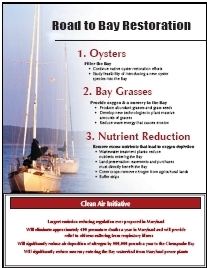
More than i-third of the pollution entering the Chesapeake Bay comes from the air. Pollutants released into the air (primarily from power plants and vehicle emissions) eventually make their way dorsum down to the earth's surface and are dispersed onto the land and transported into waterways. The emission controls on ability plants will reduce nitrogen entering the Bay by up to 900,000 pounds each year and volition reduce mercury significantly.
Why practice we need to reduce NOx and SO2?
SO2 and NOx contribute to the formation of fine particles and NOx contributes to the formation of ground-level ozone. Fine particles and basis-level ozone are associated with thousands of premature deaths and illnesses nationally each yr. In Maryland alone, as many every bit 390 premature deaths are predictable each yr as a outcome of fine particles and ground-level ozone. Additionally, these pollutants reduce visibility and damage sensitive ecosystems.
What are the adverse health effects of long-term exposure to fine particulates and ozone?
Adverse health effects that relate to both fine particles and ozone include emergency room visits, hospital admissions, and restricted activity days. Adverse health furnishings associated specifically with ozone include decreased lung function, asthma attacks, and throat and centre irritation. Backlog fine particles can cause premature bloodshed, heart attacks, upper and lower respiratory symptoms, and asthma exacerbations.
Where can I discover more information near air quality in Maryland?
The quality of our local air affects the way nosotros live and exhale. Millions of people live in areas where ground level ozone, very small particles, and toxic pollutants pose serious health concerns. Visit our Air and Radiological Health Information Heart to learn more almost how MDE ensures the air is safety to breathe for all who live in and visit Maryland.
Contact Information
For additional information on Maryland'south Good for you Air Act, please call 410-537-3245.
Center_Content

Source: https://mde.maryland.gov/programs/air/pages/md_haa.aspx
Posted by: allenfehe1983.blogspot.com
0 Response to "How Successful Has The Clean Air Act Been In Reducing Air Pollution"
Post a Comment